// Navy · RAF · Defence Aptitude Assessment (DAA)
Defence Aptitude Assessment (DAA) practice
Practise all six sections of the aptitude test for the Royal Navy, Royal Marines and RAF – step by step first, then against the clock with the real number of questions.
- 6 sections
- 8-part full mock test
- Explanation for every answer
Photo: Curioso Photography on Unsplash
The Defence Aptitude Assessment (DAA) is the aptitude test for the Royal Navy, the Royal Marines and the Royal Air Force. It replaced the RAF’s older Airmen Selection Test and covers six areas: verbal, numerical, work rate, spatial, electrical and mechanical.
Look at the practice timings: in work rate and spatial reasoning you have only a few seconds per question. That pace is hard to find on the day if you have never worked against it. The course gives you each section step by step first, then timed with the real number of questions, then as one full mock with all eight parts. We practise numerical reasoning without a calculator, so mental arithmetic is never the thing that slows you down.
What the Defence Aptitude Assessment looks like
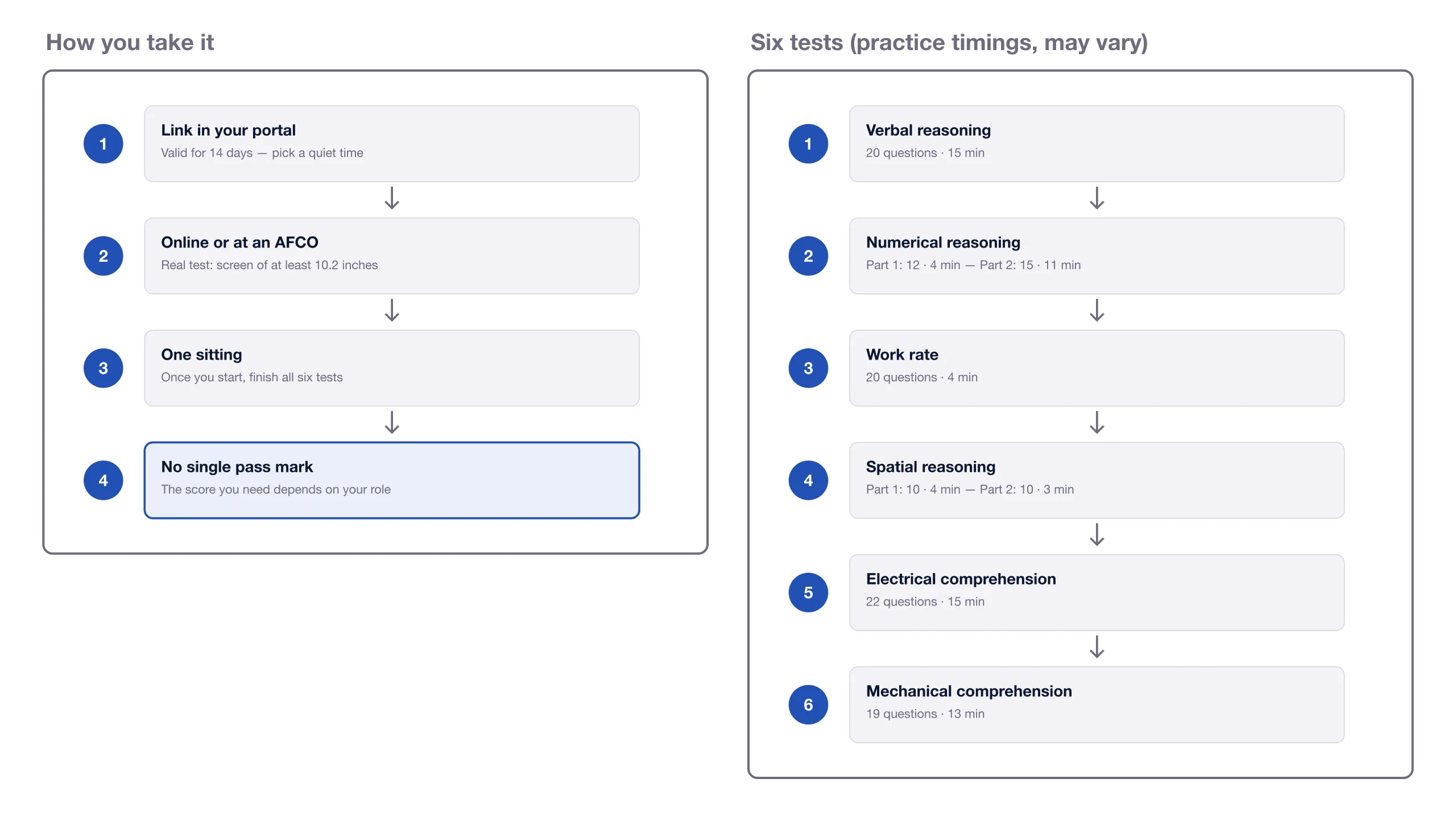
| Section | Questions | Minutes |
|---|---|---|
| Verbal reasoning | 20 | 15 |
| Numerical reasoning – part 1Quick calculations. | 12 | 4 |
| Numerical reasoning – part 2Problem solving. | 15 | 11 |
| Work rateRoutine tasks at speed. | 20 | 4 |
| Spatial reasoning – 2D | 10 | 4 |
| Spatial reasoning – 3D | 10 | 3 |
| Electrical comprehension | 22 | 15 |
| Mechanical comprehension | 19 | 13 |
Practice timings – the real test may vary. There is no single pass mark; the score you need depends on your role.
Sources:Royal Navy – Defence Aptitude Assessment · RAF Recruitment – Defence Aptitude Assessment
// Free practice
Defence Aptitude Assessment (DAA) sample questions
Answer each one yourself first, then open the answer and explanation. These are our own questions, written in the format of the real test.
Work rate and spatial reasoning are picture-based – you will find them in the course. Here are samples from the text-based sections.
Verbal reasoning
Question 1
Four technicians (A, B, C and D) each take one different task: inspection, repair, cleaning or testing. A does not do inspection or testing. C does repair. D does testing. Which task must B be doing?
- ACleaning
- BInspection
- CRepair
- DTesting
Show answer
Answer B: Inspection
C does repair and D does testing. A cannot do inspection or testing, so A must do cleaning. The only task left is inspection, so B does inspection.
Question 2
A boat crew does three drills each morning: man-overboard, fire, then abandon-ship. Today man-overboard started at 0900 and each drill lasts 15 minutes. What time does the abandon-ship drill finish?
- A0915
- B0930
- C0945
- D1000
Show answer
Answer C: 0945
Man-overboard runs 0900–0915, fire 0915–0930 and abandon-ship 0930–0945.
Numerical reasoning
Question 3
What is 15% of 240?
- A24
- B32
- C36
- D40
Show answer
Answer C: 36
10% of 240 is 24 and 5% is half of that, 12. 24 + 12 = 36. Splitting a percentage into 10% and 5% is quicker than multiplying without a calculator.
Question 4
A patrol boat covers 18 nautical miles in 1.5 hours. What is its average speed in knots (nautical miles per hour)?
- A9
- B12
- C15
- D27
Show answer
Answer B: 12
Speed = distance ÷ time = 18 ÷ 1.5 = 12 knots. Check it the other way – 12 knots for 1.5 hours is 12 + 6 = 18 nautical miles.
Electrical comprehension
Question 5
A 12 V battery is connected to two lamps, L1 and L2, in series. The voltage across L1 is 7 V. What is the voltage across L2?
- A5 V
- B7 V
- C12 V
- D19 V
Show answer
Answer A: 5 V
In a series circuit the voltages across the components add up to the supply voltage, so 7 V + V2 = 12 V and V2 = 5 V.
Question 6
Three resistors of 1 Ω, 2 Ω and 3 Ω are connected in series. What is the total resistance?
- A1 Ω
- B2 Ω
- C3 Ω
- D6 Ω
Show answer
Answer D: 6 Ω
In series, resistances add up directly – 1 Ω + 2 Ω + 3 Ω = 6 Ω.
Mechanical comprehension
Question 7
Gear X has 40 teeth and drives gear Y, which has 10 teeth. Gear X turns at 15 rpm. How fast does gear Y turn?
- A5 rpm
- B15 rpm
- C30 rpm
- D60 rpm
Show answer
Answer D: 60 rpm
Speed of the driven gear = speed of the driver × (teeth on driver ÷ teeth on driven) = 15 × (40 ÷ 10) = 60 rpm. The smaller gear always turns faster.
Question 8
In a first-class lever, such as a see-saw, which part is between the effort and the load?
- AThe effort
- BThe pivot
- CThe load
- DThe friction point
Show answer
Answer B: The pivot
In a first-class lever the pivot sits between the effort and the load. In second-class levers the load is in the middle, in third-class levers the effort.
What you get
- Learn-the-format levels for every section, with an explanation for every answer
- Timed tests with the real number of questions and time limit
- Numerical reasoning without a calculator, in both parts
- Work rate and spatial reasoning tasks drawn as pictures, just like the real test
- One full mock test with all eight parts in a row, with a summary at the end
Test-day checklist
Only advice we can source – check the details with your recruiter or training centre.
Check your device first – the real assessment needs a screen of at least 10.2 inches, such as a laptop or larger tablet.
Your link stays valid for 14 days – pick a good time within that window.
Plan a quiet slot with no interruptions – once you start, you finish the assessment in one sitting.
No suitable device at home? You can sit the DAA at an Armed Forces Careers Office on their computers.
How you practise
- 01
Learn the format
Every section step by step, without a clock, with an explanation for every answer.
- 02
Timed practice
The real number of questions and the time limit, so the pace feels normal on the day.
- 03
Full mock tests
Sit the whole thing under test conditions and see where you still lose marks.
- 04
An explanation for every answer
Each explanation shows how to get there, not just which option was right.
Ready to practise the real format?
The full Defence Aptitude Assessment (DAA) course is available on our shop. After you buy, you receive your access by e-mail.
Defence Aptitude Assessment: frequently asked questions
How many tests are in the Defence Aptitude Assessment?
Six: verbal reasoning, numerical reasoning, work rate, spatial reasoning, electrical comprehension and mechanical comprehension. Numerical and spatial reasoning are each split into two separately timed parts.
Is there a pass mark for the DAA?
There is no single pass mark. Requirements differ by role, so you do not need every answer right – but a higher score keeps more roles open to you.
Is the DAA the same as the old Airmen Selection Test (AST)?
The RAF describes the DAA as the test that was previously called the Airmen Selection Test. Old AST practice books do not follow the current format, so practise with DAA-style questions.
Where do I take the real DAA?
Once your application is accepted you are invited to take it online using your own IT, or you can sit it at an Armed Forces Careers Office using their computers.
Can I practise on my phone?
Yes – our course works on a phone. The real assessment needs a screen of at least 10.2 inches, so do at least one full mock on a laptop or tablet before the day.
Related practice
- Weighing up the British Army too? Its aptitude test works very differently – try our Army Cognitive Test practice questions.
- Planning security work while you wait for your start date? Get ready for the licence exams with our SIA door supervisor exam practice.
Facts checked on 9 October 2026.