// Army · Army Cognitive Test (ACT)
Army Cognitive Test (ACT) practice
Practise all five sections in the format you will see on the day – the question disappears before the answers appear, so you train your memory as well as your speed.
- 5 sections
- 3 full mock tests
- 34 practice levels
Photo: Filip Andrejevic on Unsplash
The Army Cognitive Test is the aptitude test you sit during British Army selection. It has five short sections, and each one tests how quickly and accurately you can hold information in your head: the question appears, disappears, and only then do you see the answers.
That disappearing screen is what catches most people out. Reading speed and maths alone are not enough – you need to have practised the format until it feels routine. Our course is built around exactly that: first learn each section without a clock, then practise against the time, then sit full mock tests in exam order.
What the Army Cognitive Test looks like
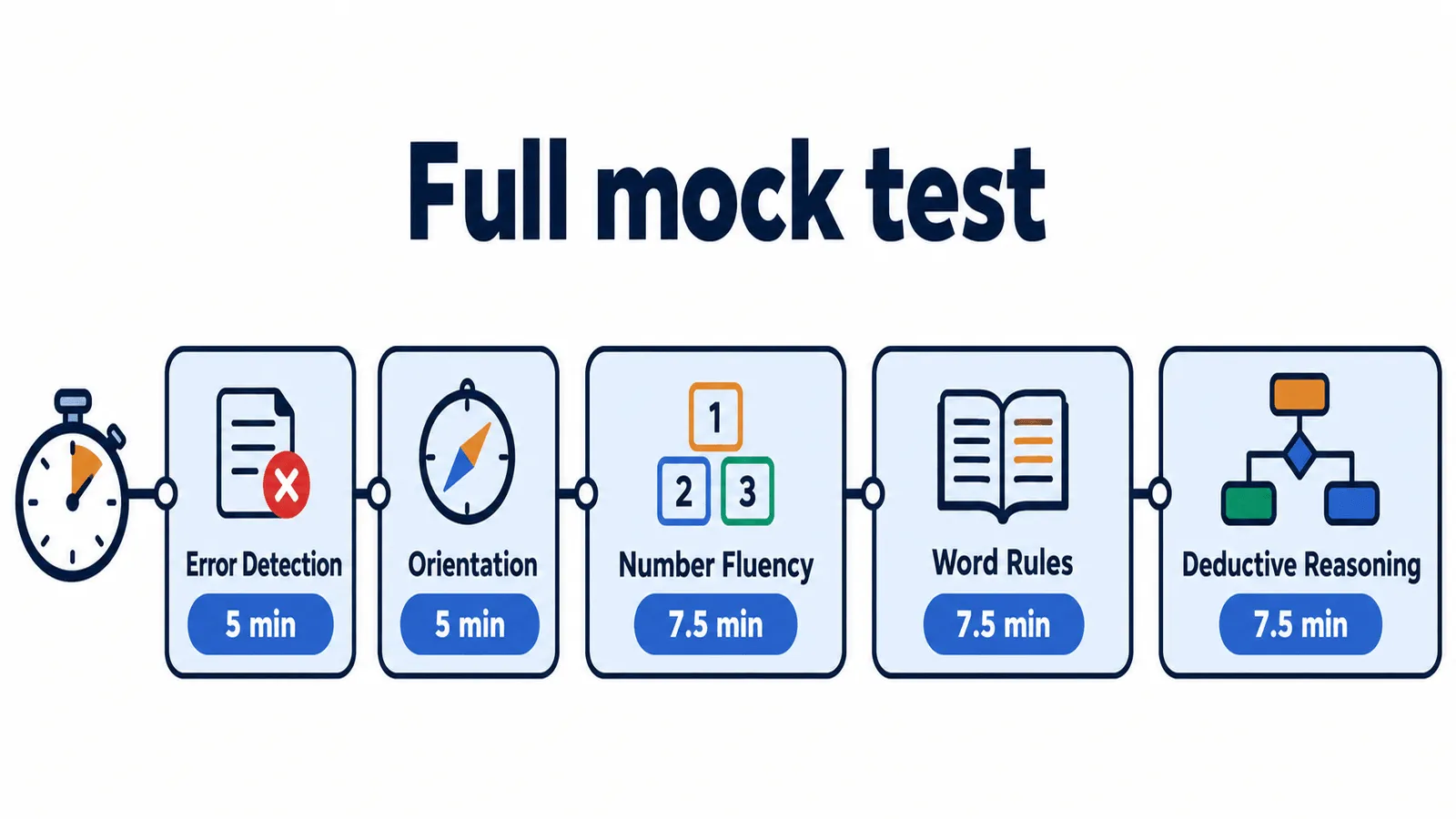
| Section | Questions | Minutes |
|---|---|---|
| Error DetectionCount the differences between an original and a copy (0–4). | 40 | 5 |
| OrientationRemember two rules | 30 | 5 |
| Number FluencyTwo calculations one after the other – which answer was higher? | 40 | 7.5 |
| Word RulesRemember three types | 40 | 7.5 |
| Deductive ReasoningTwo rules and a question | 50 | 7.5 |
Practice timings – the real test may vary. The British Army does not publish question numbers or time limits; these figures come from widely used practice material.
Source:Mindmill – Army Cognitive Test Practice Test Booklet (format of each section)
// Free practice
Army Cognitive Test (ACT) sample questions
Answer each one yourself first, then open the answer and explanation. These are our own questions, written in the format of the real test.
In the real test the first screen disappears before the answers appear. Read it once, then cover it before you look at the options.
Error Detection
Question 1
Shown briefly before the question: Original HB72 4QDN Copy HB72 4ODNHow many characters were different?
- A0
- B1
- C2
- D3
- E4
Show answer
Answer B: 1
One difference – the “Q” in the original became an “O” in the copy. Everything else is identical. Compare in small chunks of three or four characters rather than reading the whole line.
Question 2
Shown briefly before the question: Original 07:45 12/09/2031 Copy 07:46 12/09/2081How many characters were different?
- A0
- B1
- C2
- D3
- E4
Show answer
Answer C: 2
Two differences – the minutes changed from 45 to 46, and the year from 2031 to 2081. Dates and times are easy to skim, so check every digit.
Orientation
Question 3
Shown briefly before the question: Rule 1: The black arrow is above the white arrow. Rule 2: The top arrow points up.Which picture follows both rules?
- AA white arrow pointing up, above a black arrow pointing right
- BA black arrow pointing down, above a white arrow pointing up
- CA black arrow pointing up, above a white arrow pointing right
- DA black arrow pointing left, above a white arrow pointing up
Show answer
Answer C: A black arrow pointing up, above a white arrow pointing right
Only the third picture has the black arrow on top (rule 1) and that top arrow pointing up (rule 2). Check one rule at a time – rule 1 removes the first option straight away, rule 2 removes the second and fourth. In the real test you choose between pictures; here they are described in words.
Question 4
Shown briefly before the question: Rule 1: The white arrow is on top. Rule 2: The bottom arrow points down-left.Which picture follows both rules?
- AA black arrow pointing up-right, above a white arrow pointing down-left
- BA white arrow pointing up, above a black arrow pointing down
- CA white arrow pointing up-right, above a black arrow pointing down-left
- DA white arrow pointing down-left, above a black arrow pointing up-right
Show answer
Answer C: A white arrow pointing up-right, above a black arrow pointing down-left
The white arrow must be on top, which removes the first option. The bottom arrow must point down-left – the second option points straight down and the fourth points up-right. Only the third follows both rules.
Number Fluency
Question 5
Shown briefly before the question: Top: 7 × 8 Bottom: 9 × 6 + 3Which answer was higher?
- ATop
- BBottom
- CSame
Show answer
Answer B: Bottom
Top is 7 × 8 = 56. Bottom is 9 × 6 = 54, plus 3 = 57. 57 is higher, so the answer is Bottom. Work out the top sum and hold only its answer while you read the bottom one.
Question 6
Shown briefly before the question: Top: 84 − 29 Bottom: 110 ÷ 2Which answer was higher?
- ATop
- BBottom
- CSame
Show answer
Answer C: Same
Top is 84 − 29 = 55. Bottom is 110 ÷ 2 = 55. Both are the same.
Word Rules
Question 7
Shown briefly before the question: Types: Bird · Tool · Fruit Words: Robin · Hammer · CarrotHow many words matched the type in the same position?
- A0
- B1
- C2
- D3
Show answer
Answer C: 2
Robin is a bird and Hammer is a tool – two matches. Carrot is a vegetable, not a fruit, so the third position does not match.
Question 8
Shown briefly before the question: Types: Fish · Colour · Fish Words: Pike · Haddock · LettuceHow many words matched the type in the same position?
- A0
- B1
- C2
- D3
Show answer
Answer B: 1
Pike is a fish – one match. Haddock is also a fish, but the second type was Colour, so it does not count. Lettuce is not a fish. Only the position matters, not whether a word fits any of the types.
Deductive Reasoning
Question 9
Shown briefly before the question: Rule 1: Priya is taller than Tom Rule 2: Liam is shorter than Tom Question: Who is shortest?Choose your answer.
- ATom
- BLiam
- CPriya
Show answer
Answer B: Liam
Put the three in a line from tallest to shortest – Priya, Tom, Liam. Liam is shortest.
Question 10
Shown briefly before the question: Rule 1: Briefing comes before Drill Rule 2: Lunch comes after Drill Question: What is first?Choose your answer.
- ADrill
- BLunch
- CBriefing
Show answer
Answer C: Briefing
The order is Briefing, then Drill, then Lunch – so Briefing is first. Use only the rules you are given.
What you get
- “Learn the format” levels for every section: 12 questions, no time limit, an explanation for every answer
- Timed practice with the real number of questions and time per section
- A harder speed drill for every section
- Three full mock tests in exam order, with a summary across all five parts
- Questions that disappear before you answer – just like the real test
- After every level you see how your score compares with everyone else who took it
Extra – not part of the real test
- Reasoning Categories, Odds and Evens and an Alphabet Test – extra brain training, clearly marked as not part of the ACT
Test-day checklist
Only advice we can source – check the details with your recruiter or training centre.
Be well rested and eat on the morning of the tests.
Source: British Army – What can I do to prepare for the aptitude test?
Expect a touch screen at the assessment centre – it may feel slightly different from practising at home.
Source: British Army – What can I do to prepare for the aptitude test?
Read the instructions before each section carefully. If you get more than two practice questions wrong, you have to repeat the practice before the real section starts.
If anything about the process is unclear, ask your recruiter before the day.
Source: British Army – What can I do to prepare for the aptitude test?
How you practise
- 01
Learn the format
Every section step by step, without a clock, with an explanation for every answer.
- 02
Timed practice
The real number of questions and the time limit, so the pace feels normal on the day.
- 03
Full mock tests
Sit the whole thing under test conditions and see where you still lose marks.
- 04
An explanation for every answer
Each explanation shows how to get there, not just which option was right.
Ready to practise the real format?
The full Army Cognitive Test (ACT) course is available on our shop. After you buy, you receive your access by e-mail.
Army Cognitive Test: frequently asked questions
Is there a pass mark for the Army Cognitive Test?
No single pass mark. Each job role has its own score requirement, and your recruiter can tell you which roles you qualify for based on your assessment centre results. A higher score keeps more roles open.
Source: British Army – I had a 44 on my cognitive test, what roles do I get?
What is the cognitive screener on my application portal?
The screener is a short version of the test you do on your own. Its results are used as practice and to give an idea of how you are likely to do in the real test at the assessment centre.
Source: British Army – What kind of mental aptitude tests will you be required to pass?
Does the ACT measure speed or accuracy?
Both. The Army says the test measures speed and accuracy, so aim for a steady rhythm – too slow and you run out of time, too fast and you make careless mistakes.
Source: British Army – What can I do to prepare for the aptitude test?
Should I guess at random when time is nearly up?
An answer on the Army's official Q&A site says wrong answers do affect your score, although they are only part of how results are worked out. Keep answering properly rather than clicking at random.
Source: British Army – Do you get marks deducted if you get a question wrong?
How should I revise in the weeks before the test?
The Army suggests revising literacy and numeracy with online resources such as BBC Bitesize, planning study time with regular breaks and practising online psychometric tests.
Source: British Army – What can I do to prepare for the aptitude test?
Related practice
- Applying to the Royal Navy, Royal Marines or RAF instead? Their selection test is different – Defence Aptitude Assessment practice.
- Looking at security work alongside or after the Army? Revise for the licence exams with our SIA door supervisor mock exams.
Facts checked on 9 October 2026.